Speaking Clock
Notice on copyrighted work
This post uses copyrighted material from 1963 owned by the (now abolished) General Post Office. Under UK copyright law, sound recordings enter the public domain after 70 years, meaning this work will be available in the public domain on January 1st 2034. For this reason, this post has been kept private and is only accessible to those with a link to this page.
Throughout my life, I’ve rarely encountered problems getting the current time.
If I wanted the exact time, my computer always knew thanks to the network time protocol (NTP). Even without a computer, one of the clocks at home was a radio clock which would keep in sync thanks to radio transmissions. And if none of those were available, several TV stations would show the current hour and minute.
Therefore, the concept of a speaking clock never occurred to me. Speaking clocks are a telephone service which features a voice that announces the current time at regular intervals. Here’s a one minute film from 1954 which covers how it all works, archived by British Pathé.
The first time I came across a speaking clock was listening to the album Albedo 0.39 by the Greek electronic composer Vangelis. The very first song on the record, “Pulstar”, contains at the very end a 30-second sample of one of the well-known speaking clocks used in the United Kingdom, voiced by Pat Simmons. The song is available on YouTube.
Pat Simmon’s voice was used between 1963 to 1985. As of 2023, the clock is voiced by Alan Steadman, the fifth permanent voice for the UK’s speaking clock.[1]
I stumbled across a recreation of Pat Simmon’s speaking clock at asterisk-tim on GitHub. It’s a decent implementation, but the software needs to be calibrated to play on Windows or macOS, which is a hassle to setup. I thought I could do one better than this, and play the audio in the browser.
So I created a website to recreate voice. Try it out here!
Note 1: Make sure to turn the mute-switch on your phone off.
Note 2: If it doesn’t play the first time, try reloading the page.
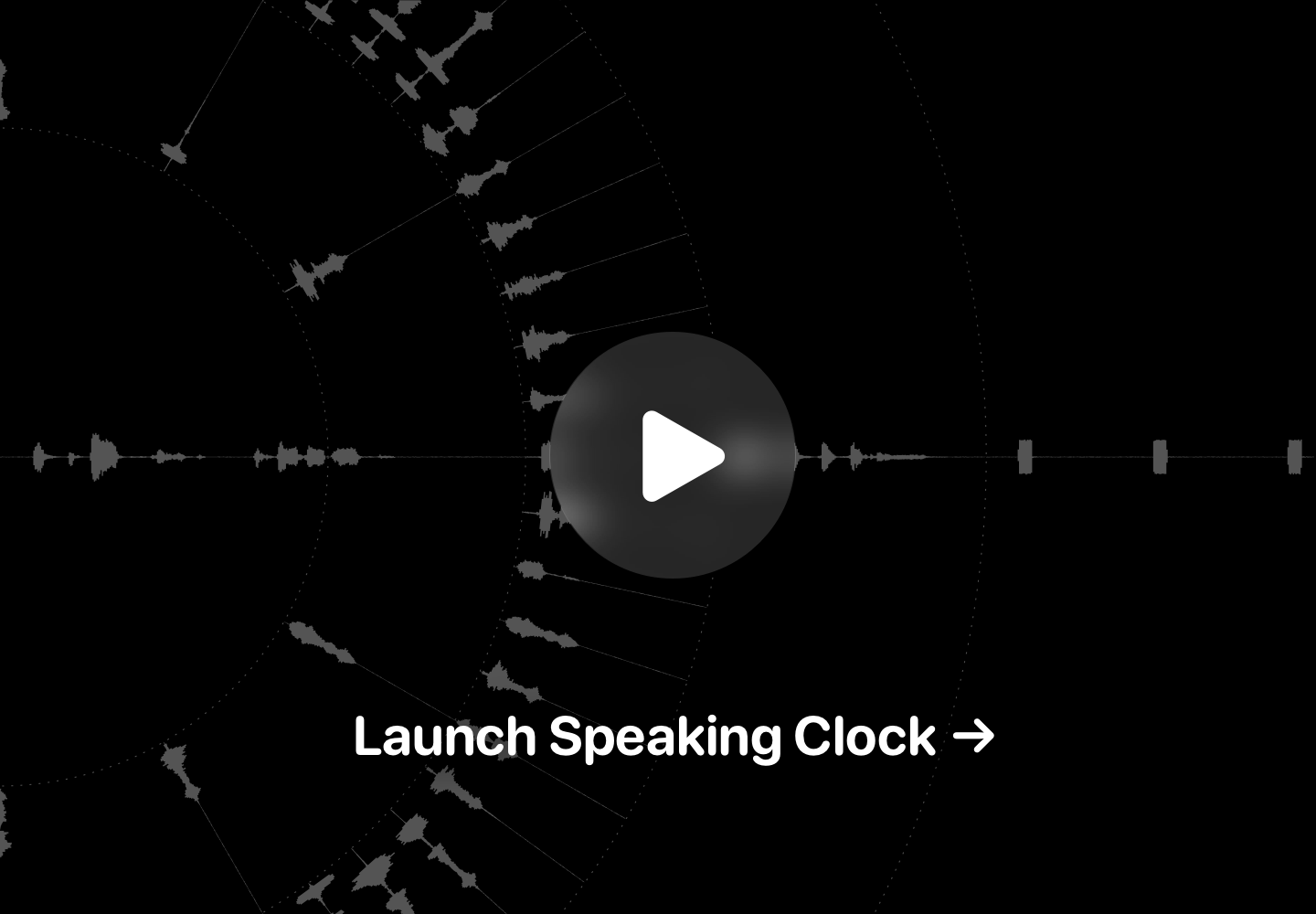
If I just recreated the voice, the website wouldn’t have much to offer. So to make the website a bit more interesting, I created a visual representation of how the clock works. All of the phrases are shown as a waveform, arranged in concentric circles. The idea is that it looks like an analog timepiece, much like the original speaking clocks in the 1950s were analog. The phrase “At the third stroke …” and the three pips are static and appear at the left and right of the screen. The rest of the phrases, representing the hour, the minute, and the second, are animated to rotate in a circle. So the waveform that is aligned horizontally is the sound that announces the current time.
Why it’s an imperfect clock
This clock assumes your system clock has the correct time. In my experience even if I have all my devices setup to use NTP to automatically set the time, they can be several seconds apart, so even NTP cannot be trusted completely.
Latency in playing audio is also an issue. Technically the audio file plays the final stroke 200 milliseconds before it actually strikes the time. But it probably takes a few milliseconds for JavaScript to play the sound and for the speakers to emit it, plus the human response time to audio is also about 160 milliseconds.[2] Using bluetooth speakers will also add latency. I doubt however that the creators of the speaking clock were even worried about such level of accuracy anyway.
Is the old speaking clock still available?
Yep, a phone number is available at telephonesuk.org.uk, but it’s expensive to call. The service appears to be hosted by a couple of telephone enthusiasts. They are in no way associated with the actual BT speaking clock service or the Telephone Heritage Group, so it’s not a service we should expect to stay preserved forever.
I also looked into other speaking clocks from other nations.
Australia’s speaking clock, voiced by Richard Peach, was shut down in 2019.[3] Thankfully, someone similar to me took the time to preserve the voice at 1194online.com.
Voice samples of Austria’s speaking clock, voiced by Renate Fuczik, have also been preserved at swisslake.ch. One person recreated a speaking clock using an Arduino.
France’s speaking clock was decommissioned in July 2022. Incomplete samples of the 2nd generation speaking clock exist thanks to the Institut National de l’Audiovisuel, which has a five hour long recording preserved on YouTube. The Paris Observatory has an article that covers the history of the French speaking clock, which also has a few snippets of audio to listen to. The French speaking clock is interesting because they decided to structure their phrases differently from English and German. For example, rather than saying:
At the third stroke it will be
hoursminutesprecisely.
At the third stroke it will behoursminutesand ten seconds.
At the third stroke it will behoursminutesand twenty seconds.
At the third stroke it will behoursminutesand thirty seconds.
At the third stroke it will behoursminutesand forty seconds.
At the third stroke it will behoursminutesand fifty seconds.
The french make the first phrase 20 seconds long, which means they remove the “50 seconds” announcement.
Au quatrième top, il sera exactement
hoursheuresminutesminutes.
hoursheuresminutesminutes dix secondes.
hoursheuresminutesminutes vingt secondes.
hoursheuresminutesminutes trente secondes.
hoursheuresminutesminutes quarante secondes.
Some other mildly interesting facts
- In 2012, the Met Police spent £35,000 on calling the speaking clock over a two year period. Similarly the Ministry of Defence spent £40,000. Sounds ridiculous, but as the first article notes, it’s such a small amount that in the grand scheme of things there are more important issues that the Met Police have to answer to. (i.e. Tabloid magazines used the news as rage bait)
- Several samples of speaking clocks are used in the song “Life & Space” on Yoshinori Sunahara’s Take Off and Landing album. This includes a French, German, Japanese, and American voices. You can find the song on YouTube.
Citations
- ^ BT Group Newsroom, “… the new voice of the BT Speaking Clock …”
- ^ Kosinski, “A literature review on reaction time.” – “For about 120 years, the accepted figures for mean simple reaction times for college-age individuals have been about 190 ms (0.19 sec) for light stimuli and about 160 ms for sound stimuli (Galton, 1899; Fieandt et al., 1956; Welford, 1980; Brebner and Welford, 1980).”
- ^ Silva, “Talking Clock continues …”
References
- At the third stroke… the new voice of the BT Speaking Clock is Alan Steadman from Dundee – published by BT Group Newsroom, 2016 (Archive.org)
- A literature review on reaction time. – by Robert J. Kosinski, published by Clemson University 10.1 (2008): 337-344.
- Talking Clock continues to tick online after Telstra’s September shutdown silenced ‘George’ – published by ABC Radio Melbourne, 2019 (Archive.org)